Note To My Critics:

The links to the many sites that I've included contain information that I believe to be relevant, be it the graphics, the videos, the undercover investigations, etc. . Exposing & and ending the brutality and savagery inflicted on the non-human animals is what I am focused on. I strongly believe that every voice against animal abuse/exploitation is of value and -and- collectively we have the power to end it. I am here for the animals, not for anyone's approval and for that I make no apologies. ** I do not promote violence towards humans. ___________________________________________________ Bookmark and Share

Thursday, May 13, 2010

Study Finds Mice Express Pain Facially; Just Like Us

Study Finds Mice Express Pain Facially; Just Like Us

support animal-welfare
 
posted by: alicia graef 23 hours ago
Study Finds Mice Express Pain Facially Just Like Us


A new study published on Sunday in the journal Nature Methods has concluded mice make facial expressions when they're in pain.
Jeffrey Mogil at McGill University in Montreal, Canada worked with colleagues and Kenneth Craig, a psychologist who studies human pain at the University of British Columbia in Vancouver, to develop a mouse grimace scale.
According to the Telegraph, This was done by injecting stomachs and paws with pain-inducing substances, including acetic acid, mustard oil, and capsaicin, the ''hot'' ingredient in chillies.
Animals were also injected with a chemical that triggers bladder cystitis, and made to suffer nerve damage.
The ''pain faces'' were identified by comparing video images of non-suffering mice with those in pain.
They were listed as: orbital tightening (eye squeezing), nose bulge - a rounded extension of skin on the bridge of the nose - bulging cheeks, ears drawn apart and back, and whiskers held against the face or standing on end.
This was apparently justified by saying that no study has ever been conducted to study facial reactions to pain, or to determine whether facial reactions were corresponding to being tortured, despite clear evidence that animals do make facial expressions to show emotion and communicate.
Mogil reportedly didn't want the photos published because of the potential backlash from animal rights activists, but Wired's got the photos, if you care to see the faces of bad science.
He was also right, people who care about animal suffering were outraged.
''People should be clear that this study was not in any way intended to improve or positively impact on the welfare of mice (or any other animal). It was not intended in anyway to mitigate painful situations for mice used in research, rather just to find a new way of determining if a mouse is showing signs of pain, said Dr Ned Buyukmihci, veterinary adviser at the British Union for the Abolition of Vivisection (BUAV).
Maybe this study will have everyone thinking a little harder about why birds, rats and mice aren't covered under the Animal Welfare Act, since they can suffer after all.
Read more: mice, animal welfare, animal testing, animal cruelty, mouse grimace scale, mice facial expressions, mice pain

Wednesday, April 14, 2010

Lufthansa Airlines Transports Beagles Testing Laboratories

MySpace.com: Read Bulletin
We recently obtained heartbreaking photos showing at least 50 beagles confined to crates and loaded like cargo on a Lufthansa transport plane. The beagles were destined for a Charles River Laboratories (CRL) animal-testing facility in Scotland where they will likely be poisoned and killed in drug and pesticide tests.


CRL condemns tens of millions of animals to confinement, poisoning, mutilation, and death in its own laboratories and those of its customers. The company was recently fined $14,000 after 32 monkeys were cooked to death when a room at its facility in Reno, Nev., overheated.

By transporting these animals, Lufthansa is facilitating and profiting from the abuse of animals in laboratories. Please take a moment to let Lufthansa know that this practice is unacceptable.


Send a quick e-mail to Lufthansa vice president Jens Bischof and urge him to join other progressive airlines like Qantas and Cathay Pacific by enacting a policy against transporting animals destined for use in laboratories.

Tell Airline to Stop Transporting Animals to Laboratories

Thank you for giving a voice to animals in need!

Sincerely,
Justin Goodman
Research Associate Supervisor
Laboratory Investigations Department


Sunday, December 20, 2009

Why You Should NEVER, NEVER Go To The Circus

Please Visit www.ringlingbeatsanimals.com to make a donation to save the abused elephants.


The Ringling Bros are on trial.


As is that previous video was not bad enough, there's more sickening abuses in the video below.

http://www.youtube.com/watch?v=RL51SQN1aPc


Tuesday, November 10, 2009

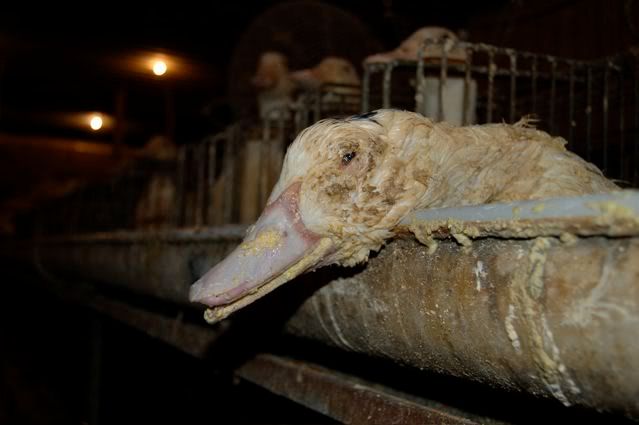
Live Plucking Of Geese And Eider Ducks For Down

http://www.wspa-usa.org/pages/2659_duvets_a_nightmare_for_geese.cfm

http://idfl.com/articles/IDFLLivePlucking11Feb2009.pdf


Portal of Heart
Reposted by
Kindness of Strangers for the Earth and Animals

Thank you!
Wildlife

Martha

Moonwarriors

LIVE PLUCKING OF GEESE AND EIDER DUCKS FOR DOWN

Photobucket

Summary of "What the Compassionate Consumer Should Know About Down," PETA NEWS, Nov.-Dec. 1988.
In a recent Napa Register news article, "The short, sad life of a Hungarian goose," reporter Henry Kamm describes one source of all that down in the stores each winter: "The geese of the Hungarian Soviet Friendship Cooperative Farm live short and unhappy lives. They are hatched without benefit of Mother Goose in ovenlike breeders. Until they are eight weeks old, the goslings are fed either a diet 'good for livers or good for feathers.' Neither is good for the birds' happiness."
If the geese are white, they are destined to be plucked for their down (the soft, fine feathers of young birds), which will go into pillows, parkas and comforters. These geese lead "particularly uncomfortable lives. Four or five times during the short span allotted to them they are plucked." The farm owner conceded that even Western European countries that allow force feeding for pate de foie gras draw the line at plucking the birds alive.
"After the last plucking, when winter approaches and cost accountants say it is more expensive to heat the sheds than the feathers are worth, the geese are slaughtered for their meat."
*Eider ducks. Any of several large sea ducks (genus Somateria) that live in northern regions of Europe, Asia, and North America. Eiderdown is the soft, fine breast feathers, or down, of the eider duck, used as a stuffing for quilts, pillows, etc. (from Webster's New World Dictionary, 1979)
straightline
Summary of "Live-Plucked Geese Documented in Video," The Animals' Voice, Jan.Feb.March 1993 (Vol. 6, No. 1), p. 43.
Beauty Without Cruelty Charity in England has obtained color video evidence of the live plucking of geese for feathers and down on Hungarian factory farms. The video shows terrified birds being lifted by their backs and then having all their body feathers ripped out. The frantic geese struggle to escape, causing strained muscles and sometimes broken limbs.
Veterinarians and even geese breeders call this practice "extremely cruel," particularly the plucking itself and the tying of the birds' legs over their backs. Rippers are paid piece rate and therefore speed is of the essence. Experienced rippers can rip up to five ounces of down in three to four minutes—an average pillow takes about 1.5 lbs. of filling. The Hungarian Feather Association confirms that 25,000 tons of goose feathers are exported annually from Hungary (95% of its total production). It estimates 50% of the down and 40%-45% of the feathers are live plucked. The remainder come from slaughtered birds.
Geese normally live in small family units and mate for life, living up to 20 years and flying long distances. But not the geese on Hungarian factory farms, where some 20,000 geese are crammed into a small area. The geese are live plucked two or three times a year before being slaughtered or force fed for another year to produce pate de foie gras (swollen goose liver, a product found in the United States, imported from France). Under normal conditions, a goose develops its first full coat of feathers at about eight weeks old and will molt (gradually shed old feathers and grow new ones like all birds) each year.
Down is in high demand for bedding, and world production adds up to thousands of tons. The main market is Germany. Countries where live-plucking takes place include China, Poland, and Hungary, and allegedly France and Israel.
Synthetic fillings are durable, easier to clean, are less likely to cause allergies, and cost less.
For more information about live plucking or details about the video evidence, write BWC Charity, 57 King Henry's Walk, London N1 INH England.
straightline
Live Plucking is Painful. See M.J. Gentle, L.N. Hunter, "Physiological and behavioural responses associated with feather removal in Gallus var domesticus [chickens]," Research in Veterinary Science, Vol. 50 (1990), pp. 95-101.
"Nociceptors [pain receptors] have been identifies in the skin of several avian species [including ducks, geese, and chickens]. The follicular wall of the feather is richly supplied with general somatic afferent (sensory) fibres, and nerves are present in the papilla, pulp and feather muscles. . . The feather is firmly held in the follicle. . . . [F]orce [was] required to remove the dorsal feathers of White Leghorn hens using a steady pull. . . .
". . . In conclusion, from the results presented here and from those of previous experiments it seems likely that feather removal is painful to the bird. Zimmerman (1986) has defined pain in animals as an aversive sensory experience caused by actual or potential injury that elicits progressive motor and vegetative reactions, results in learned avoidance behaviour and may modify species specific behaviour, including social behaviour. Feather removal [​experimentally done to Leghorn hens by these researchers] results in tissue injury which gives rise to motor behaviour and cardiovascular changes which when repeated results in stress-induced immobility and thus satisfies most of the criteria in this [M. Zimmerman's] definition of pain."


SOURCE


Posted by Moonwarriors

straightline


Reposted by Kindness of Strangers E_CO Member


BULLETINS

Tuesday, October 27, 2009

Article Points to Human and Animal Welfare Costs of Long-Distance Farm Animal Transport | Humane Society International

October 26, 2009

A chapter in the upcoming book Handbook of Disease Outbreaks: Prevention, Detection and Control implicates the long-distance transport of farm animals in the spread of human and animal diseases.

The chapter, "Disease and transport: a costly ticket around the world," was co-authored by Michael Greger, M.D., Humane Society International's director of public health and animal agriculture, along with Sofia Parente, Michael Appleby and Jennifer Lanier of The World Society for the Protection of Animals. It examines the animal and human health implications of transporting animals over long distances and explores measures to limit long-distance transport of animals for slaughter.

The paper concludes that replacement of long-distance, live farm animal transport with a carcass-only trade is "not only necessary but urgent."

Facts

  • More than 60 billion animals are reared for meat, eggs and milk annually worldwide. Most are transported for slaughter, often over long distances, both within and between countries.
  • According to the Food and Agriculture Organization of the United Nations, "[t]ransport of livestock is undoubtedly the most stressful and injurious stage in the chain of operations between farm and slaughterhouse."
  • The FAO describes live animal transport as "ideally suited for spreading disease."
  • Given the associated "serious animal and public health problems," the Federation of Veterinarians of Europe has called for the replacement of the long-distance transportation of live animals for slaughter as much as possible by a carcass-only trade.

Follow HSI on Twitter.

Humane Society International and its partner organizations together constitute one of the world's largest animal protection organizations — backed by 11 million people. For nearly 20 years, HSI has been fighting for the protection of all animals through advocacy, education, and hands-on programs. Celebrating animals and confronting cruelty worldwide — On the web at hsi.org.


Article Points to Human and Animal Welfare Costs of Long-Distance Farm Animal Transport | Humane Society International

Karakul Lamb Fur: Cruelty on the Catwalk


Thank You!
One Voice


Because their unique, highly prized curly fur begins to unwind and straighten within three days of birth, many karakul lambs are slaughtered when they are only 1 or 2 days old. The rest don’t even make it that far. In order to get a karakul fetus’s hide—called “broadtail” in the industry and valued for its exceptional smoothness—the mother’s throat is slit and her stomach slashed open to remove the developing lamb. A mother typically gives birth to three lambs before being slaughtered along with her fourth fetus, about 15 to 30 days before it is due to be born. As many as 4 million karakul lambs are slaughtered for their fur every year.


The fur industry tries to justify karakul lamb fur as a byproduct,
but with a single karakul lamb coat selling for up to $12,000 and “broadtail” fetus coats fetching as much as $25,000, it’s little surprise that the mother sheep and her baby’s skinned carcass are usually regarded simply as trash.


And who’s profiting from such disgusting cruelty? Designers Ralph Lauren, Karl Lagerfeld, Fendi, Prada, Dolce & Gabbana, and Jean-Paul Gaultier use astrakhan, and Neiman Marcus and Bloomingdale’s sell it on their own racks.

But fashionistas with a heart aren’t buying it. Claudia Croft, fashion editor of the Sunday Times Style Magazine in London recently called astrakhan “the cruelest and most vicious fur.” And “Material Girl” Madonna hasn’t been seen in her astrakhan coat since designer pal Stella McCartney scolded her for “wearing a fetus.

What can you do about karakul lamb fur?


DON”T BUY OR WEAR ANY FUR.


If you see karakul lamb fur for sale, write to the store owners or managers, let them know where it comes from, and urge them to pull it from the shelves.


If you read an article about karakul lamb fur in a newspaper or magazine, write a letter to the editor
.


For more information, visit FurIsDead


Posted by: One Voice

Friday, October 16, 2009

Swine Flu ~Retribution

Karma: karma |ˈkärmə|
noun
(in Hinduism and Buddhism) the sum of a person's actions in this and previous states of existence, viewed as deciding their fate in future existences.
• informal destiny or fate, following as effect from cause.


~We are only getting what we deserve~


Tuesday, September 1, 2009

Humane Farming?

Humanity
1. The quality of being humane.
2. The quality of being human.
3. All of the living human inhabitants of the earth.

There needs to be a different name for the human race. There is precious little ‘humanity’ in humanity. All of the sufferings that people inflict on other people and on animals along with the destruction of our planet shows an absence of humanity within the human race. Humans are consumed with hate, greed, lust for blood and power. Humans are a plague upon the planet a plague upon animals. The beauty of ‘life’ is lost on Man. With the exception of the Animal Rights Activist who are a minority among us I am sickened by 'Man' . Where will 'Man' be in 10, 20, 30 years from now? Just follow the trail of pain, death & destruction and you'll find man.....until there is nothing left to kill, until there are no trees left to cut down, until there are no rivers left to pollute, until there is no blood left to spill.


Tuesday, August 25, 2009

Transportation of Farm Animals Investigation

Originally Posted by:
Lizzie Wylder Apr 22

This is a video of a 2005 investigation of a US farm animal transportation done by Compassion Over Killing. Unfortunately, this is not an isolated case. Animals being transported to slaughterhouses are crammed tightly into trucks, and travel for more than 28 hours without food, water or rest. They are exposed to harsh weather, and die from heat exhaustion or freeze to death -- often being frozen to the side of the truck -- before even making it to the slaughterhouse. These animals are treated as nothing more than money gaining products from the time they are born, during transport, and when they are slaughtered. They have done harm to no one, and yet are given no mercy. Go to tryveg.com and cok.net to learn more about animals who are raised for food and the best way you can help them.


http://www.youtube.com/watch?v=HeUWDdngafQ&feature=player_embedded

Tuesday, August 18, 2009

Change.org - Shot for a Tulip - say NO to Cayuga Heights NY's deer-killing plan


Shot for a Tulip - say NO to Cayuga Heights NY's deer-killing plan

To: Trustee Kate Supron (Cayuga Heights Trustee), Trustee David Donner (Cayuga Heights Trustee) and Mayor Jim Gilmore (Cayuga Heights Mayor)

Started by: Jennifer Stein

Cayuga Heights -- a village embedded within the larger community of Ithaca, New York -- has been said to have the most Ph.D's per capita of any municipality in America. Yet its trustees are about to approve a dangerous, immoral, and frankly bizarre plan that would call for every single deer in the village to be either violated or killed. It seems these human-habituated animals’ appetite for tulips, heirloom tomatoes, and ornamental shrubbery has, in the minds of the current mayor and trustees, created a situation so dire and unacceptable, that action of the most extreme sort is not only justified, but urgently required.

The first phase of their plan involves capturing 30-60 female deer, surgically sterilizing them, then puncturing their ears with numbered tags and encumbering their necks with radio collars. These are the "lucky" individuals. The intended fate of every other deer in Cayuga Heights, including pregnant does and fawns, is to be shot dead at bait sites at undisclosed locations and times. This annually performed massacre will be carried out by out-of-town contractors who earn their living exterminating wildlife. The ethical grotesquery of this plan appears to be lost on those who conceived it, who seem to be oblivious to the mental and emotional torture that will be experienced by the few deer chosen to survive, not to mention the many people who care about these gentle animals. Year after year, deer in and around Cayuga Heights will be lured by piles of corn into the kill zone, and those marked for survival will watch as their herd mates are brutally killed right in front of them. Were such a sadistic policy to be carried out against dogs or cats, or horses, an outraged crowd would spontaneously rise up to stop it. But the deer, ironically, because they live free of direct human control and are no individual's private property, are somehow seen as unworthy of moral consideration. The plan was just announced in July, yet the village trustees voted to BAN ALL PUBLIC COMMENT about their deer-killing proposal at their August and September meetings, during which they are expected to approve this controversial proposal. Because those who have tried to be voice of the voiceless have been silenced themselves, we need people around the world to contact these legislators and demand that they let voices on all sides of the issue be heard, and that they adopt proven, non-violent alternatives to the outrageous killing plan they have proposed. Do we really want to live in a society where bureaucrats meet behind closed doors to arbitrarily decide how many of each species are allowed to live, then send technicians out to mark the few chosen to survive as ornamental reminders of a bygone era, doomed to move among us as freaks festooned with the trappings of their utter domination by humans? Do we want to cover the eyes and ears of our children as unsuspecting animals are methodically executed in our neighbors' backyards? There are many people in and around Cayuga Heights who, through wise plant choices, and skillful use of fencing and deer repellents, enjoy beautiful gardens without causing harm to anyone. Mass killing and extreme control of the area's indigenous wildlife is neither necessary, nor ethical, nor safe. And if it is scientific at all, it represents science at its most twisted. Everything about this plan is emblematic of the mindset that is destroying our planet. Because the trustees of Cayuga Heights have rejected proven and practical non-violent approaches to reducing deer-human conflict, because they refuse against all reason to allow residents to erect fences high enough to safeguard their plantings, because they have silenced public comment on their controversial proposal -- should the rest of us just sit back and do nothing? Should we accept armed men firing deadly weapons in residential neighborhoods, to protect tulips? Or is it possible, with all the brilliant, creative and compassionate people living in Cayuga Heights and the Ithaca community, that a more sensible approach can be found? Help us be heard! The letter below will go to the Mayor and two key members of the board of trustees. PLEASE ALSO COPY THE TEXT OF THIS LETTER AND SEND BY EMAIL TO THE OTHER TRUSTEES:

Trustee Robert Andolina: randolina@cayuga-heights.ny.us

Trustee Ron Bors: rbors@cayuga-heights.ny.us

Trustee Diana Riesman: driesman@cayuga-heights.ny.us

Trustee Bea Szekely: bszekely@cayuga-heights.ny.us

Visit our special “Conscience Calling Card” pages and find out how you can help:

http://www.cayugadeer.org/conscience/gilmore.htm

THANK YOU for speaking out for those who are trying to be a voice of the voiceless and who have now been silenced themselves. .•This petition ends on Sep 21.

Tuesday, July 7, 2009

Stop The Brutal Killing of Dogs For Meat

Image and video hosting by TinyPic

Sign The Petition

Over 2 million dogs are brutally killed in South Korea every year.
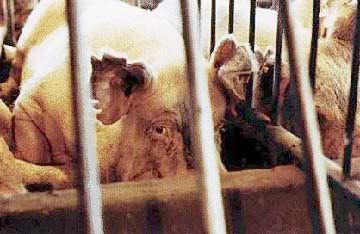
That's over 5,000 dogs a day who get strangled, burned, electrocuted or beaten to death for their meat.

Please Follow This Link For More Info: http://www.uniteddogs.com/stopkillingdogs/

The South Korean government has accepted Animal Protection Laws which make animal torture illegal, but those laws have never been properly enforced in the country. The dog meat industry continues to thrive and the officials are reluctant and indifferent to ban it.


Although forbidden to advertise themselves on main streets or in English, over 6,000 restaurants today serve dog meat in South Korea. And they don't get closed down


You can help us change the life of millions of dogs.
International support against dog torture and dog meat consumption is the only way to put pressure on the South Korean government to protect animal rights for real and ban the dog meat industry in all forms. This petition will be presented to the Korean officials in Seoul by the Korea Animal Rights Advocates when at least or more than 1 million signatures have been collected.

This petition is different from any other petition made in support for Korean dogs because of its great scope. People across the world are able to see the "Stop Killing Dogs" page in English, French and in many other languages, and understand that it is not a harmless ancient tradition or anything inevitable.

Sign The Petition

Wednesday, June 10, 2009

Take Action: End Animal Use in Military Medical Training

On June 3, PCRM and a group of former military medical officers filed a formal petition with the Department of Defense requesting that it end the cruel and outdated use of monkeys, goats, and pigs to train personnel. With the petition, we also submitted


https://secure2.convio.net/pcrm/site/Advocacy?pagename=homepage&page=UserAction&id=259&autologin=true

Watch the Monkey and Goat Training Videos


Chemical Casualty Care Training on Monkeys

Seizures, breathing difficulty, and possible death: The vervet monkeys used in the military’s chemical casualty care training experience horrific symptoms. The animals are given a toxic dose of the drug physostigmine in an exercise designed to simulate the effects of a nerve agent attack. The exercise—which takes place at Aberdeen Proving Ground in Maryland—is demonstrated in the video below obtained by PCRM through the Freedom of Information Act. Using monkeys in this exercise is profoundly inhumane, and it also distracts military personnel from the real-world, clinically valid training they need to treat chemical casualties.


Combat Trauma Training on Goats

An instructor cuts a live goat with a scalpel to create traumatic wounds in the military video below, obtained by PCRM through the Freedom of Information Act. The use of goats and pigs for combat trauma training is suboptimal due to, among other issues, the animals’ anatomical and physiological differences from humans. Compared with humans, goats and pigs have smaller torsos and limbs, thicker skin, and important differences in anatomy of the head and neck, internal organs, rib cage, blood vessels, and airway. Many of these differences are demonstrated in this film for the Army Medical Departments Tactical Combat Medical Care course. The instructor in the training film repeatedly references significant differences between training on live goats and human casualties.

Tube Thoracostomy with Chest Tube Insertion


Combat Application Tourniquet and Pressure Dressing


https://secure2.convio.net/pcrm/site/Advocacy?pagename=homepage&page=UserAction&id=259&autologin=true

Monday, June 8, 2009

China's Wanton Abuse of Dogs/Animals


http://www.animalsasia.org/


Image and video hosting by TinyPic ~Boycott China ~

THE CAN FROM CHINA


I was buying food the other day at the Country Market. On the label of
some products, it said, "From China". For example, the "Our Family"
brand of Mandarin oranges says right on the label, "From China".

I was shocked!! For a few more cents I bought the Liberty Gold brand or
Dole, which is from
California . Are we Americans as dumb as we appear --- or --- is it that we just do not think?

While the Chinese, knowingly and intentionally, export inferior and
even toxic products and dangerous toys and goods to be sold in American
markets, the media wrings its hands and criticizes the Bush
Administration for perceived errors. Yet 70% of Americans believe that
the trading privileges afforded to the Chinese should be suspended.


Well, duh..why do you need the government to suspend trading privileges?

SIMPLY DO IT YOURSELF,
AMERICA !! Simply look on the bottom of every product you buy, and if it says 'Made in China ' or 'PRC' (and that now includes Hong Kong ), simply choose another product, or none at all. You will be amazed at how dependent you are on Chinese products, and you will be equally amazed at what you can do without. Who needs plastic eggs to celebrate Easter? If you must have eggs, use real ones and benefit some American farmer. Easter is just an example; the point is do not wait for the government to act. Just go ahead and assume control on your own.

THINK ABOUT THIS If 200 million Americans refuse to buy just $20 each of
Chinese goods, that's a billion dollar trade imbalance resolved in our
favor...fast!! The downside? Some American businesses will feel a
temporary pinch from having foreign stockpiles of inventory. Wahhhhhhhhhhhh

The solution? Let's give them fair warning and send our own message:
Most of the people who have been reading about this matter are planning
on implementing this on June 4, and continue it until July 4. That is only
one month of trading losses, but it will hit the Chinese for 1/12th of
the total, or 8%, of their American exports. Then they will at least
have to ask themselves if the benefits of their arrogance and
lawlessness were worth it. Remember, June 4 to July 4.

EVEN BETTER. .. . START NOW.

Send this to everybody you know. Let's show them that we are Americans,
and NOBODY can take us for granted. If we can't live without cheap
Chinese goods for one month out of our lives, WE DESERVE WHAT WE GET!

Pass it on,
America


Tuesday, June 2, 2009

Factory Farms Mutilate Baby Pigs

Reposted with Thanks From:
One Voice

Factory Farms

Mutilate Baby Pigs


Photobucket


On factory farms, the following procedures are performed on piglets only weeks old. The pig-flesh industry refuses to use painkillers even though local anesthesia would cost about 1 penny per baby pig.


Castration

Workers slice into a piglet’s scrotum and pulls out his testicles while the piglet screams and writhes in pain. Imagine asking a veterinarian to neuter your dog—but without pain relief. That would be a felony in most states.

“Ear-notching”


Large hunks of each piglet’s ears are sliced off with scissors to make identification patterns.


“Ear-notching”


Piglets have their tails cut off to reduce tail biting, a habit that arises from boredom and frustration in stressful factory farm conditions. Scientists testify that the pain is severe and continues for many days.


“Tooth-clipping”


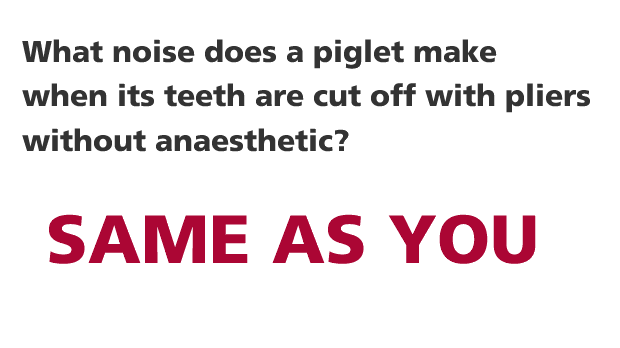
The piglet’s incisor teeth are cut off with pliers that are similar to wire cutters so that they can’t cause injuries by chewing on themselves or their neighbors when the extreme confinement drives them insane. Imagine dental surgery without anesthetics.


WARNING:
This video shows scenes of animal cruelty and tooth clipping filmed undercover in intensive factory farms


Photobucket


One Voice
Photobucket

Tuesday, May 19, 2009

Bow Hunting-A Veterinarian Perspective ( Sign Petition)

Photobucket


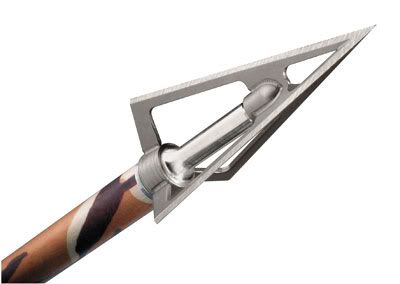
Bowhunting Report. Plus ,
Why there are too many deer a MUST READ


Please sign the Petition against the sadistic bowhunting.

Friday, May 1, 2009

Steer Busting; The most deadly rodeo event

Steer Busting;

The most deadly rodeo event


Reposted with thanks to: : SHARK

SHARK exposes the deadly cruelty of rodeo steer busting, sanctioned by the Professional Rodeo Cowboys Association (PRCA).


___________________________________________________________


www.BustSteerBusting.com

www.TheCruelTruth.com

www.SHARKonline.org

Tuesday, April 28, 2009

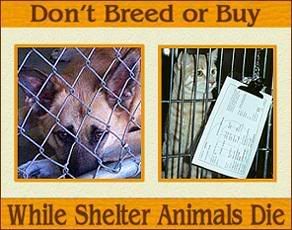
Pet Stores & Puppy Mills: A Cruel Partnership


Photobucket
What is a Puppy Mill?
Photobucket
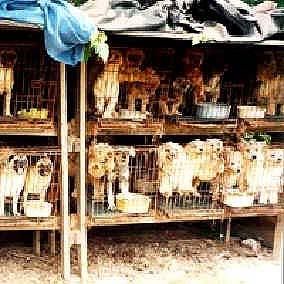
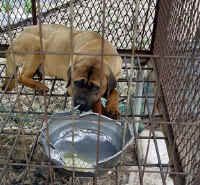
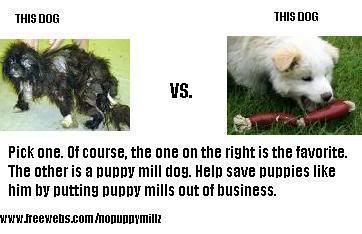
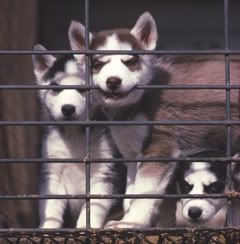
Puppy mills are commercial kennels that mass-produce dogs in squalid, overcrowded cages, without proper veterinary care, shelter from heat or cold, or adequate food and water. Substandard care and attention are given to these dogs since puppy mill owners care more about profit than the health of the dog. Cat breeding occurs under similar conditions to supply pet stores with kittens..

Stop Puppy Mills

Health and Behavior Problems

Photobucket
Puppy mill dogs often suffer from starvation and are forced to sit all day and sleep in their own excrement. Even though pet store puppies may look healthy at first sight, many are incubating disease at the time of sale, including the deadly Parvo virus, parasites and skin diseases. Many also have serious congenital defects like eye and hip problems. These dogs are also prone to serious behavior problems since they've been confined to cages without human interaction during their first crucial months of life..

Stop Puppy Mills

Pet Store Connection

Photobucket
Of the roughly 150,000 dogs and cats that end up in Washington shelters each year, more than half are put to death because there aren't enough homes to go around (nearly half are puppies and kittens). Puppy mills carelessly add to the overpopulation crisis by selling over 500,000 dogs each year through America's pet stores..
Photobucket
Roughly 90% of puppies in pet stores come from puppy mills. If people chose to adopt puppies and kittens rather than purchase them at pet stores, commercial breeders would have no outlet to sell their "product"..
Photobucket

Stop Puppy Mills

Registration Papers-No Guarantee

Photobucket
The American Kennel Club themselves say that they "cannot guarantee the quality or health of dogs in its registry." Well-known dog behaviorist, Brain Kilcommons has said, "Mixed-breed dogs are what nature intended of dogs, and are on the whole, healthier, often more intelligent, of more even disposition, and live longer lives than many purebred dogs"..
Photobucket

Help Stop Puppy Mills

Photobucket
• Do not purchase animals from pet stores that do business with puppy mills and cold-hearted backyard breeders

• Adopt a rescued animal from your local animal shelters

• Discourage others from purchasing animals from pet stores which will make more money for the cruel puppy mill operation and continue to breed miserable lives for these innocent animals

• Spread awareness about the facts of puppy mills to your family, friends and community

Please help end this cycle of misery. Give these innocent animals hope that there is a life without fear or pain waiting for them.. If not you, who? If not now, when?


If you have any questions or concerns, please contact us and we will respond as soon as we are able
Photobucket

www.myspace.com/blessings_of_the_merciful

Friday, April 24, 2009

Do You Know The Truth About Pigs?

One Voice

Photobucket


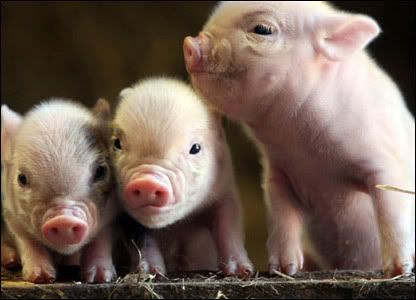
Most people don't have the privilege of getting to know a pig. For most of us, the thought of pigs conjure images of dirty, greedy animals living in their own waste. We couldn't be more wrong! Pigs don't perspire, and so wallow in mud to keep themselves cool. They are naturally very clean animals and, if given the choice, they prefer to cool themselves down in fresh water. When in a natural environment, pigs build communal nests and toilet areas away from their sleeping area


"I like pigs.. Dogs look up to us. Cats look down on us. Pigs treat us as equals. "
British politician and Nobel Prize Laureate Winston Churchill


Photobucket

Smarter than Dogs?


Pigs are remarkably intelligent creatures thought by many to be smarter than dogs. They can be trained to respond to simple voice commands, and are easily toilet trained. Studies have revealed that pigs have a long memory and are able to focus on specific tasks even better than some primates. Research conducted at Bristol University found that pigs are cleverly competitive with other members of their herd, and to avoid confrontation will wait until nobody is looking to sneak away hidden food. "This sort of behaviour suggests that pigs can compete with each other in quite complex and 'cerebral' ways," says Dr Mendl of Bristol University.


"[Pigs] have the cognitive ability to be quite sophisticated. Even more
so than dogs and certainly three-year-olds. "
Professor Donald Broom of Cambridge University Veterinary School


Photobucket


Playful Pigs


Pigs develop highly complex social structures and form strong bonds with other members of their group. At the age of around 3 weeks, piglets begin to play with other piglets, and for the majority of weeks thereafter will interact more with each other than with other members of their herd. It is during this time of play and interaction that strong bonds are formed, often lasting the duration of their lives


Photobucket

Mother and Child


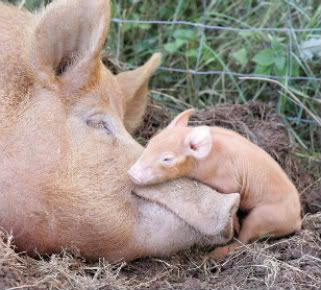
About 24 hours before giving birth, pregnant mother pigs will temporarily leave the social group in order to collect branches and soft material to build a nest. Shortly after giving birth, piglets will often move to the head of the sow and touch noses, vocalise, and then begin suckling. The mother will stay isolated in her nest with her newborns for the first week, which allows her to develop a strong bond between herself and her piglets. Mothers are known to 'sing' to their offspring, which is believed to inform them when her milk is flowing.


A Healthy Appetite


Most of a pig's day is spent foraging and eating. The end of their snout contains has many tactile receptors as the human hand, and is a highly specialised and sensitive tool. This, along with their exceptional sense of smell, enables pigs to locate and uncover tasty treats such as seeds, roots, and truffles. Unlike dogs or humans, pigs never dangerously overeat-even when given access to unlimited food.


Pigs are affectionate, protective, playful,
intelligent and social animals
who suffer tremendously within
intensive farming systems.


…Behind closed doors

LIES THE

CRUEL TRUTH


Photobucket


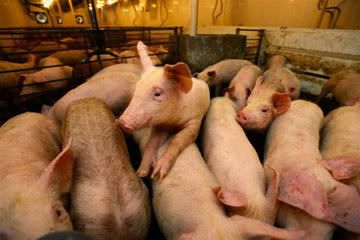
Approximately 100 million pigs are raised and slaughtered in the US every year. As babies, they are subjected to painful mutilations without anesthesia or pain relievers. Their tails are cut off to minimize tail biting, an aberrant behavior that occurs when these highly-intelligent animals are kept in deprived factory farm environments. In addition, notches are taken out of the piglets' ears for identification.

By two to three weeks of age, 15% of the piglets will have died. Those who survive are taken away from their mothers and crowded into pens with metal bars and concrete floors. A headline from National Hog Farmer magazine advises, "Crowding Pigs Pays..", and this is exemplified by the intense overcrowding in every stage of hog confinement systems. Pigs will live this way, packed into giant, warehouse-like sheds, until they reach a slaughter weight of 250 pounds at 6 months old.

The air in hog factories is laden with dust, dander, and noxious gases, which are produced as the animals' urine and feces builds up inside the sheds. Studies of workers in swine confinement buildings have found sixty percent to have breathing problems, despite their spending only a few hours a day inside confinement buildings. For pigs, who spend their entire lives in factory farm confinement, respiratory disease is rampant.


Photobucket


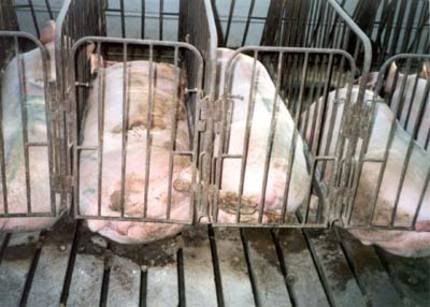
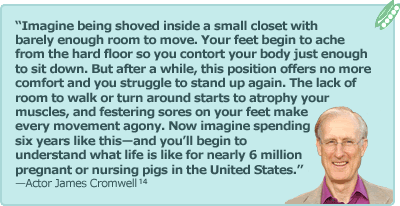
Modern breeding sows are treated like piglet-making machines. Living a continuous cycle of impregnation and birth, each sow has more than 20 piglets per year. After being impregnated, the sows are confined in gestation crates — small metal pens just two feet wide that prevent sows from turning around or even lying down comfortably. At the end of their four-month pregnancies, they are transferred to similarly cramped farrowing crates to give birth. With barely enough room to stand up and lie down and no straw or other type of bedding to speak of, many suffer from sores on their shoulders and knees. When asked about this, one pork industry representative wrote, "..straw is very expensive and there certainly would not be a supply of straw in the country to supply all the farrowing pens in the US"


Photobucket


Numerous research studies conducted over the last 25 years have pointed to physical and psychological maladies experienced by sows in confinement. The unnatural flooring and lack of exercise causes obesity and crippling leg disorders, while the deprived environment produces neurotic coping behaviors such as repetitive bar biting and sham chewing (chewing nothing).


After the sows give birth and nurse their young for two to three weeks, the piglets are taken away to be fattened, and the sows are re-impregnated. An article in Successful Farming explains, "Any sow that is not gestating, lactating or within seven days post weaning is non-active," and hog factories strive to keep their sows '100 % active' in order to maximize profits. When the sow is no longer deemed a productive breeder, she is sent to slaughter.

The overcrowding and confinement is unnatural and stress-producing since pigs are actually very clean animals. If they are given sufficient space, pigs are careful not to soil the areas where they sleep or eat. But in factory farms, they are forced to live in their own feces, urine, vomit and even amid the corpses of other pigs.

In addition to overcrowded housing, sows and pigs also endure extreme crowding in transportation, resulting in rampant suffering and deaths. As one hog industry expert writes:


Photobucket


Death losses during transport are too high — amounting to more than $8 million per year. But it doesn't take a lot of imagination to figure out why we load as many hogs on a truck as we do. It's cheaper. So it becomes a moral issue. Is it right to overload a truck and save $. 25 per head in the process, while the overcrowding contributes to the deaths of 80,000 hogs each year?


Prior to being hung upside down by their back legs and bled to death at the slaughterhouse, pigs are supposed to be 'stunned' and rendered unconscious, in accordance with the federal Humane Slaughter Act. However, stunning at slaughterhouses is terribly imprecise, and often conscious animals are hung upside down, kicking and struggling, while a slaughterhouse worker tries to 'stick' them in the neck with a knife. If the worker is unsuccessful, the pig will be carried to the next station on the slaughterhouse assembly line
— the scalding tank —
where he/she will be boiled, alive and fully conscious


Please think

before you eat another sausage link!!

One Voice

Photobucket

Sunday, April 19, 2009

Hunting~Wildlife Abuse


Photobucket

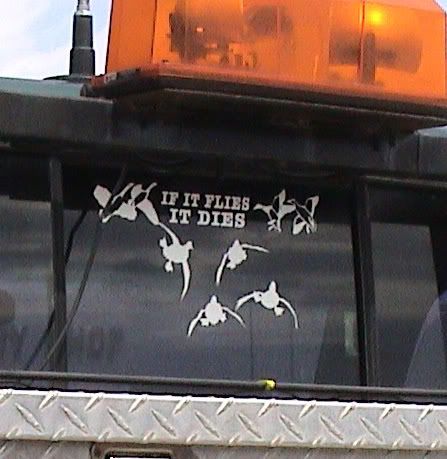
A proud and callous hunter's truck displays the slogan "If it flies, it dies." Apparently, for New Jersey bowhunters, kicking a disoriented bird into half-flight is enough of a reason to kill.


On May 24th, the organization, Animal Protection PAC, held a press conference to expose members of the United Bowhunters of New Jersey and urge a criminal investigation. According to the bowhunting group's own website, pheasants were bought, "put to sleep", and taken to private land, whereupon the birds then had to be kicked and prodded into flight, only to be shot down at close range. The UBNJ video and comments have since been removed from their site and the bowhunters have threatened to sue the animal protectors.


SHARK's anti-hunting web site is named HuntersRapeNature. com. This has drawn heavy criticism from hunting apologists. Hunters insist that they are conservationists and sportsmen, and that they respect those they wantonly slaughter.

Their own video footage refutes their argument. Not only are these people obviously thrill killers of cage-raised birds, but there has been a profound silence from the rest of the hunting community about this matter that speaks volumes about the entire world of hunting.

Where is the protest against this unseemly, sleazy slaughter from the National Rifle Association (NRA), the International Bowhunting Association, North American Bowhunters, National Hunters Association, Professional Bowhunters Society, International Archery Foundation, Pheasants Unlimited, Ducks Unlimited, Buckmasters, Christian Sportsmen's Fellowship, Hunting & Shooting Sports Heritage Fund, U.S. Sportsmen's Alliance or Safari Club International--to name just a few? There is no protest. This is the world of hunting.


_______________________________________________________________

All tyranny needs to gain a foothold is for people of good conscience to remain silent. ~ Thomas Jefferson

Image and video hosting by TinyPic

Two roads diverged in a wood, and I—
I took the one less traveled by,
And that has made all the difference.
~Robert Frost (1874–1963)

Saturday, April 18, 2009

TEN FAST FACTS about FUR

Reposted with thans to:
Fallen Angel


Reposted with thanks by~
Martha
Spirits of Justice
♥DEECATLUVR♥
Marie-Adopt Rulon!
Help Stop the Cruelties!
One Voice


Get The Facts:

Photo Sharing and Video Hosting at Photobucket

Ten Fast Facts about Fur


1 -More than 50 million animals are violently killed for use in fashion every year.


2 -Methods used to kill animals for their fur include gassing, electrocution, and neck breaking. Fur-bearing animals are also caught and killed in barbaric body-gripping traps.


3 -Neither fur nor fur trim is a byproduct of the meat industry. Rabbit fur is often falsely identified as a byproduct of meat production. The truth is, few rabbit skins are obtained from slaughterhouses, which more often dispose of the undesirable pelts of rabbits bred to make meat. Fur comes from animals who are factory-farmed or trapped purely for fashion.


4 -The fur trim market is an equal, if not greater, threat to animals than is the making of fur coats. Fur trim is not what’s “left over” from making full-length fur coats. Thousands of animals are killed simply to provide trimming effects for fashion. Even purchasing the tiniest bit of fur trim supports the cruel fur industry.


5- Garment or accessory labels cannot always be relied upon to accurately identify the type of animal fur used in an item. API advises erring on the side of caution and compassion by not buying items that you cannot verify are fur-free.


6 -Cat and dog fur can enter the U.S. market undetected and be sold as fur trim. While there is a ban on the import of domestic dog and cat fur in the U.S., the animal’s fur may be mislabeled or the item may be valued less than $150, and thus not be required to carry a label identifying the source of the fur.


7 -Fur “farms” or “ranches” are not humane alternatives to trapping. The terms are euphemisms used by the fur industry to describe confinement facilities in which fur-bearing animals are caged and killed. Currently, there are no federal laws providing protection for the millions of animals held in these factory-like farms.


8 -Seals are still being clubbed and brutally slain for their fur. The Canadian seal hunt is the world’s largest remaining commercial slaughter of marine mammal; close to a million harp seals were authorized to be killed between 2003 and 2005. The use of seal fur in fashion is a contributes to this massacre.


9 -Although historically, the fur trade played a role in the development of the early North American economy, tradition never justifies abuse. There are many cultural practices once seen as acceptable that are now viewed as horrific relics of a more brutal time.


10 -The fur industry is a threat to our environment and wildlife, contributing to higher energy costs, pollution, land destruction, and reductions in populations of wild animals, including endangered and threatened species who may be accidentally trapped and killed.


This is a film about the tragedy hidden behind the high fences of fur farms.


One Voice

_______________________________________________________________

All tyranny needs to gain a foothold is for people of good conscience to remain silent. ~ Thomas Jefferson

Image and video hosting by TinyPic

Two roads diverged in a wood, and I—
I took the one less traveled by,
And that has made all the difference.
~Robert Frost (1874–1963)

________________________________________________________________


Free Veg Starter Kit TeachKind.org Chained Dogs

blogger templates | Make Money Online