You can help us change the life of millions of dogs (PETITION).
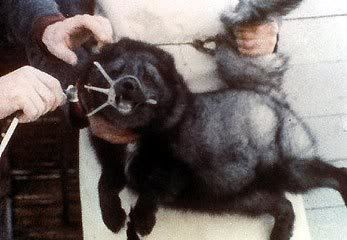
International support against dog torture and dog meat consumption is the only way to put pressure on the South Korean government to protect animal rights for real and ban the dog meat industry in all forms. This petition will be presented to the Korean officials in Seoul by the Korea Animal Rights Advocates when at least or more than 1 million signatures have been collected.
This petition is different from any other petition made in support for Korean dogs because of its great scope. People across the world are able to see the "Stop Killing Dogs" page in English, French and in many other languages, and understand that it is not a harmless ancient tradition or anything inevitable. Visit: Stop Killing Dogs
"Auschwitz begins whenever someone looks at a slaughterhouse and thinks:They are only Animals"
The links to the many sites that I've included contain information that I believe to be relevant, be it the graphics, the videos, the undercover investigations, etc. . Exposing & and ending the brutality and savagery inflicted on the non-human animals is what I am focused on. I strongly believe that every voice against animal abuse/exploitation is of value and -and- collectively we have the power to end it. I am here for the animals, not for anyone's approval and for that I make no apologies. ** I do not promote violence towards humans.
___________________________________________________
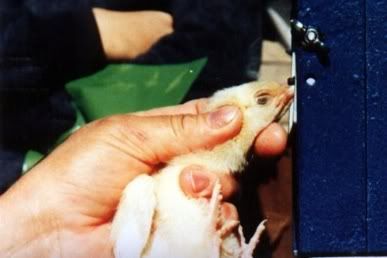
The non-profit organization Mercy for Animals has recently released a video shot at an Iowa egg hatchery showing workers killing unwanted male chicks by placing them in a grinder while still alive. The shocking footage is now spreading quickly around the internet along with calls for the company in question, Hy-Line, to reform its practices. Male chicks are routinely discarded because they don't produce eggs and don't grow large enough or quickly enough to be sold for meat. While there is nothing illegal about killing chicks in this way, the footage also contains images of chicks slipping through the grinder and dying slowly on the factory floor, which is a violation of corporate and industry ethical standards.
According to the AP, Mitch Head, the spokesperson for the United Egg Producers responded to the video by saying, "There is, unfortunately, no way to breed eggs that only produce female hens.” He continued, "If someone has a need for 200 million male chicks, we're happy to provide them to anyone who wants them. But we can find no market, no need." The chicken processor, Hy-Line on its website says it produces about 30,000,000 chicks a year, and by that count, it would mean that it also kills about 30,000,000 male chicks a year as well.
Undercover footage: Warning: Graphic Images. Not for the squeamish or children.
This is not the first time that undercover footage has lead to calls for change in the food industry. The Hallmark/Westland meat recall, the largest in US history, was touched off by footage shot by a Human Society volunteer who took a job at the slaughterhouse. These videos point to the rapid change towards transparency that is being forced upon businesses. Companies that expect that they can operate behind closed doors in a way that would offend the sensibilities or ethical standards of the public are being forced to change. But will consumers be willing to pay more, or spend more time, for food that is not produced in an industrial fashion? Adam Werbach is the author of Strategy for Sustainability TWITTER: @adamwerbach Although we may not be able to stop these shocking practices today, we can pressure a large player in the chicken meat industry, McDonalds, to adopt more humane methods for slaughter.
Humanity 1. The quality of being humane. 2. The quality of being human. 3. All of the living human inhabitants of the earth.
There needs to be a different name for the human race. There is precious little ‘humanity’ in humanity. All of the sufferings that people inflict on other people and on animals along with the destruction of our planet shows an absence of humanity within the human race. Humans are consumed with hate, greed, lust for blood and power. Humans are a plague upon the planet a plague upon animals. The beauty of ‘life’ is lost on Man. With the exception of the Animal Rights Activist who are a minority among us I am sickened by 'Man' . Where will 'Man' be in 10, 20, 30 years from now? Just follow the trail of pain, death & destruction and you'll find man.....until there is nothing left to kill, until there are no trees left to cut down, until there are no rivers left to pollute, until there is no blood left to spill.
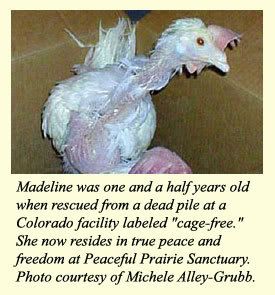
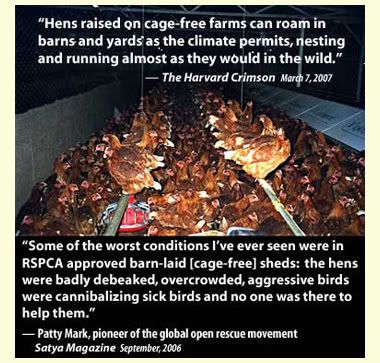
As a strategy to end the use of battery cages, for example, several Animal Orginizaion are encouraging members and supporters to persuade individuals and institutions to switch to eggs labeled “cage-free.” One of the architects of this campaign has stated that the term “cage-free” is not misleading at all — for even though the hens are confined in artificial indoor environments, technically speaking, they are not in actual cages. But being technically factual and telling the truth are not necessarily the same. Just ask members of the general public to imagine the lives of chickens who produce “cage-free” eggs. Most will likely envision something akin to the mythical “Old MacDonald’s Farm,” contented animals freely wandering about a bucolic barnyard. The reality? Millions of young hens standing shoulder to shoulder in huge enclosed warehouses, forced to dwell day and night in their own waste, enduring air so foul that workers sometimes wear gas masks to prevent permanent damage to their lungs. Just like their battery-caged sisters, “cage-free” hens are brutally debeaked, force molted (starved for days to restart an egg laying cycle), and, of course, slaughtered when they are no longer of use. Or, as one investigator discovered, if no buyer can be found for their ravaged bodies, they might just be packed into steel drums and gassed, the piles of their lifeless remains sent to a landfill or used as compost. Not to mention the millions of male chicks who, incapable of laying eggs, are unceremoniously suffocated in plastic bags or ground alive into fertilizer or feed, their lives snuffed out before they even begin. “New and Improved” Abuse?
If we pursue justice by collaborating with industry, by helping develop and promote what we tell ourselves are slightly less hideous forms of exploitation, are we not attempting to displace one form of abuse with another?
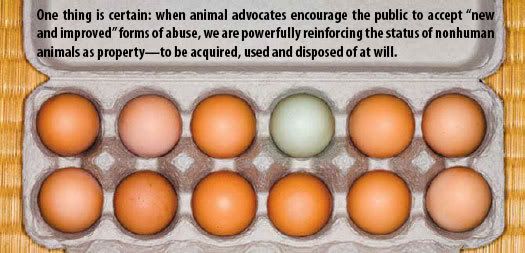
While it is questionable whether such a strategy could eventually lead to the end of exploitation, one thing is certain: when animal advocates encourage the public to accept “new and improved” forms of abuse, we are powerfully reinforcing the status of nonhuman animals as property—to be acquired, used and disposed of at will. We are also significantly bolstering the credibility and positive public image of an industry with a long history of betraying public trust.
Even more troubling, we animal advocates cannot successfully carry out such a strategy without ourselves directly taking part in misleading the general public. Consider, for example, what it takes to successfully “sell” the idea that buying and consuming eggs labeled “cage-free“ is socially responsible, and even compassionate. If the full reality of “cage-free” egg production—or any other systematized exploitation of animals—were to be revealed, wouldn’t it be impossible to convince large numbers of people to support it?
Hence, to promote “cage-free” eggs, we must step across the invisible but critical line that separates an advocate from an apologist.
From Cage-free to Cruelty-free: How Truthiness Becomes Fiction
Let’s examine some of the statements that have appeared in local media where “cage-free” egg campaigns have run. Watch as the pressure to close the sale leads to the inevitable blurring of fact and fiction:
One student animal rights group characterizes their “cage-free” campaign as trying to get their college’s food service to no longer purchase its eggs from “large factory farms with cruel conditions.” The group’s leader states that “factory farms and caged hens are harmful to the environment,” and that “cage-free eggs are good for the animals and local farmers. ”
At another college, animal advocates state that if the university would switch to eggs labeled “cage-free,” “we could pride ourselves on knowing that these birds were living a decent life,” and that they'd no longer be supporting “environmentally unsustainable practices that exploit the land, the workers, the animals. ”
The truth is, most “cage-free” eggs are produced on industrialized farms, and there is little evidence to suggest “cage-free” production techniques are less harmful to the environment. They are certainly not “good for” animals.
Said one doctoral candidate, “If entire nations across Europe can ban battery cages and go cruelty-free, then I’m optimistic that [our university] certainly can as well!”
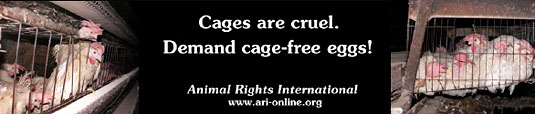
Animal Rights International, headed by Peter Singer, paid to have these billboard style ads run on the sides of New York City buses. Peter Singer's utilitarian approach guides the policies of many of the animal organizations currently collaborating with the animal exploiting industries.
But can an industry that mutilates and kills the young animals it exploits truthfully be called “cruelty-free”?
At another college, a student sponsor of a successful “cage-free” campaign says, “It’s good that this university can show that we’re compassionate toward animal rights. ” So switching to eggs labeled “cage-free” is now an expression of animal rights, a philosophy that rejects all exploitation and boycotts the consumption of animal products?
“We’re happy to do it,’’ said the food manager for a Fortune 500 company. “There’s a ripple effect that I think will happen. Other companies also will want to ensure humane treatment of animals. ’’
As one astute activist pointed out, terms that can be used in a relative sense when communicating with animal activists, are now being applied in an absolute sense when selling consumers on these “new and improved” animal products. So while one might choose to argue that some forms of exploitation and killing are less inhumane or less cruel than others, an informed advocate cannot honestly characterize any form of exploitation and killing as humane or free of cruelty. Yet this is exactly what the public is being led to believe.
Imagine what it means to do all the work needed to pull down the veil covering over the horrific injustice of battery egg production, and then, to turn around and methodically cover it up again with a new and improved facade: “Cage-free” eggs—the cruelty-free, socially responsible, environmentally sustainable alternative. Good for the animals, good for farmers, good for workers, good for you.
This, at a time when more and more people around the world are being addicted to an animal protein-centered diet, the proven cause of most chronic illness. This, at a time when we face record obesity, and avian influenza looms as the next pandemic. This, at a time when UN researchers have determined that animal agriculture produces more global warming impact than all the world’s cars, trucks, buses, planes, trains and ships combined. And Let’s Not Forget, They’re Tastier Too
A repeating theme of news stories around the “cage-free” egg campaign—actually common to much of the coverage of advocate-approved labeling schemes—is how delicious these “new and improved” animal products are. One campus dining service conducted a taste test, failing to find even one student who didn’t think “cage-free” eggs tasted better. Another dining manager was quoted complimenting their freshness. She spoke of how one of their chefs “made banana bread with the eggs and said the bread rose to be lighter and fluffier,” and how “students seem interested in tasting the eggs,” concluding that “people seem to be eating more eggs just to try them out. ”
Is there any doubt our cause is being co-opted?
But how can anyone blame well-meaning activists for contributing to the growing smorgasbord of mis- and dis-information? After all, they’ve been convinced by people they admire that if they tell the truth, they will not reduce suffering as much as by offering up the false reassurances of truthiness. They’ve been convinced that replacing one form of abuse with another is a viable path to ending exploitation. As the core values and principles of the movement are perversely put in service of selling the very products of suffering and exploitation they were intended to abolish, people of integrity and goodwill become increasingly disoriented. They lose their ability to recognize they’ve been drawn into a destructive conflict of interest, mistaking it for “pragmatism” and “common sense. ”
A Half Truth is a Whole Lie
Is it time to take a look in the mirror? Do we really want to convince our most idealistic young people that skillful manipulation is a surefire path to a better world? That PR spin, and not teaching, is the answer? Do we want to perpetuate the destructive fantasy that a social justice movement can be run like a multi-national corporation?
Ignorance, denial and dishonesty are at the very root, not just of exploitation itself, but of the social and psychological forces that allow its toleration. When we are willing to sacrifice the truth, to dilute its power in order to accrue short-term gains, however noble they may seem to be, we break free of our ethical moorings and begin to drift off course, inevitably carried away by the same currents that drive those caught up in exploitation.
In our heart of hearts, we know there is a better path. If we take the time to listen, our conscience will show us the way. Tribe of Heart
When people think of cruelty, they often think of a person starving or beating an animal. In other words, they think of actions that are against the law. They may also think of things done by other nations, such as whale hunting, bear farming, bull fighting, or clubbing seal pups.
Certainly all of these actions are cruel, but animals also suffer much closer to home.
Mostly people don't think about everyday suffering!
Animals killed for food, battery hens, laboratory animals, animals that are trapped, poisoned, or hunted for sport. These actions aren't illegal, but they cause suffering to more individuals than people who starve or beat their animals.
So what is cruelty? In what ways do animals suffer?
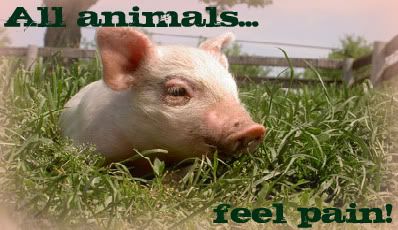
Pain. All animals with backbones (vertebrates) feel pain like we do. Hooking fish, fire branding cattle, catching animals in steel-jaw traps, cutting tails off lambs and beaks off hens, all cause pain.
Stress and Fear. Vertebrate animals feel anxiety like we do. Transport is very stressful for animals, especially live export overseas. Being pulled out of the water and left to suffocate causes great stress to fish. Dairy calves taken from their mother after 1 day and trucked to slaughter at 1 week of age suffer greatly.
Frustration. Animals need more than food and water for their well-being - they also need to be able to carry out the behaviour that is natural to their species. Otherwise they become frustrated and may develop abnormal behaviour, just like a mentally disturbed person. Signs of frustration can be seen in battery hens, pigs in tiny stalls, rabbits in laboratory cages, foxes and mink on fur farms, and some zoo and circus animals.
Animal Cruelty in...
Factory Farms
Animals in factory farms are treated as machines, not sentient beings who feel pain and emotions just like dogs or cats. Their welfare is disregarded in the name of profit, and they suffer horrendous conditions in mind boggling numbers. On standard commercial egg farms, hens are kept in such small cages that they cannot even lift one wing. Factory farmed animals have their beaks, tails, horns and genitals chopped off with no anesthesia. All animals on factory farms are kept intensively and painfully confined. At the end of their miserable lives, they are all sent to violent commercial slaughterhouses where stunning procedures often fail, and the animals are dismembered or skinned while still conscious. ..
In order to boycott factory farm cruelty altogether, as well as the devastating effects of factory farming on the environment and human health, compassionate people all over the world are going vegan.
Laboratories
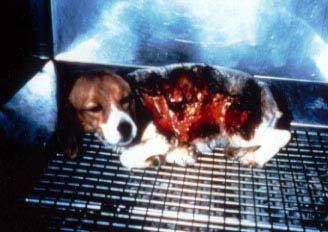
Vivisection is the cutting into or dissecting of a live animal. Billions of non-human animals have been burnt, crushed, sliced, electrocuted, poisoned with toxic chemicals, and psychologically tormented in the name of scientific curiosity. What have we learned from all of this suffering? That animal research is inherently unethical, inevitably wasteful, and wholly unreliable. The U.S. squanders approximately $18 billion per year on animal experiments, much of which is funded by taxpayers, even though alternatives are less expensive and can be used repeatedly. And what do we get for our dollars? "Too much suffering for too little knowledge. "
Fur Farms
More than 45 million animals worldwide, including raccoon dogs, rabbits, foxes, mink, and chinchillas, are raised in cages and killed each year for their fur. Not only are cage-raised animals killed inhumanely, but they suffer from numerous physical and behavioral abnormalities induced by the stress of caging conditions. After spending their short lives in squalid conditions, animals raised on fur farms are killed by cruel methods that preserve the pelt, such as gassing, neck-breaking and anal electrocution. Some are skinned alive!
Animals living in the wild are the unseen victims of human exploitation.
Their lives are cruelly cut short for the sake of greed, vanity, and the so-called thrill of sadistic bloodsports
Every form of violence and cruelty imaginable is inflicted upon wild animals and yet the public is largely unaware of these abuses.
Trapping
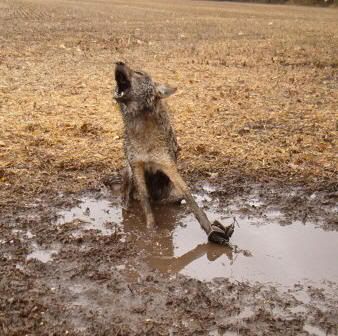
Millions of wild animals, including bobcats, coyotes, foxes, lynx, raccoons, and wolves, suffer and die in traps each year. Countless dogs and cats, deer, birds and other animals—including threatened and endangered animals—are also injured and killed each year by the indiscriminate traps. Traps, including steel-jaw leghold traps, body-gripping traps, and wire neck snares, are inhumane devices that inflict great pain and suffering.
Hunting
Although it was a crucial part of humans’ survival 100,000 years ago, hunting is now nothing more than a violent form of recreation that the vast majority of hunters do not need for subsistence.
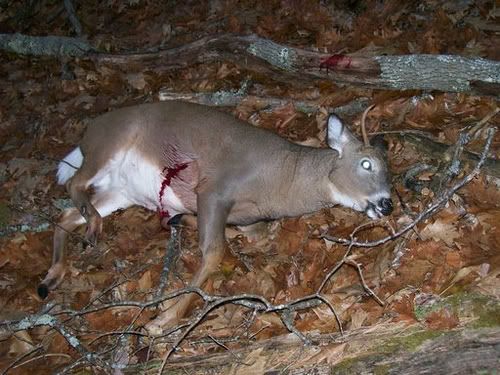
Many animals suffer prolonged, painful deaths when they are injured but not killed by hunters.
Hunting disrupts migration and hibernation patterns and destroys families. For animals like wolves, who mate for life and live in close-knit family units, hunting can devastate entire communities. The stress that hunted animals suffer—caused by fear and the inescapable loud noises and other commotion that hunters create—also severely compromises their normal eating habits, making it hard for them to store the fat and energy that they need in order to survive the winter.
"Oh what a wicked thing it is, for flesh to be the tomb of flesh, for the body's cravings, to fatten on the body of another, for one creature to continue living through one live creature's death. In all the richness that earth, the best of mothers, tenders to us, does nothing please except to chew and mangle the flesh of slaughtered animals?" ~Pythagora