


Note To My Critics:

Thursday, April 22, 2010
Sunday, February 14, 2010
The Sheer Terror of Slaughter ~Meat Eaters Ingest
"I woke up in the middle of the night after dreaming about cows dangling from ropes tied around their hind legs. The animals moved slowly down the line, twitching as the life ebbed out of their bodies, blood spurting from gashes in their necks delivered moments earlier by a man
wearing a bloodstained smock.
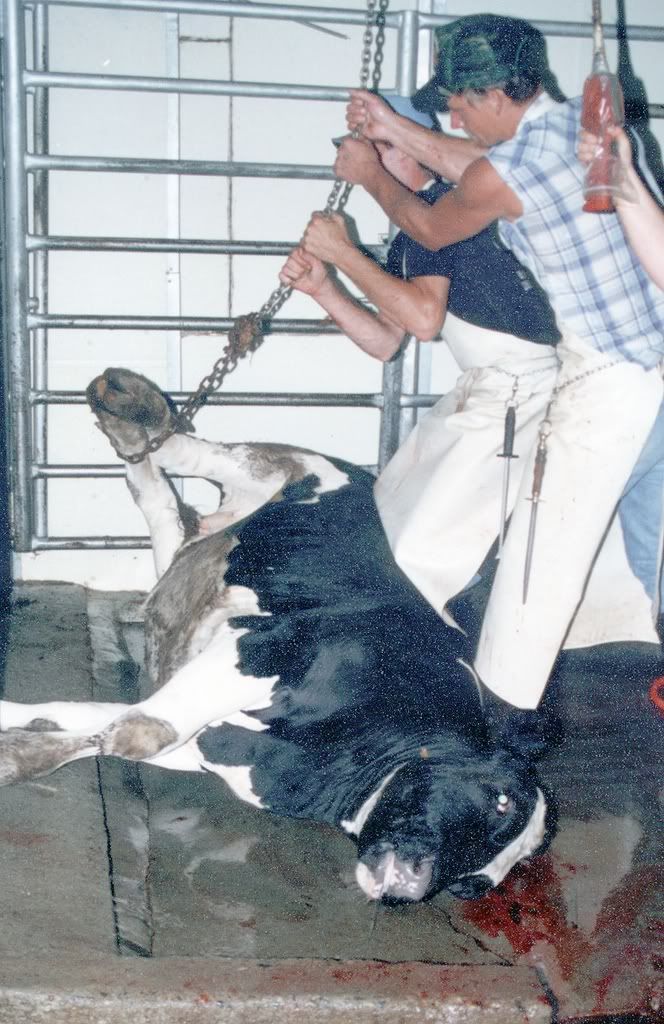
Occasionally, there would be an animal, still alive, mooing loudly and
shaking spasmodically, seeking a way to escape. In my dream, one animal
made eye contact with me, her eyes bulging, wild with pain and fear.
Once awake, I envisioned their enormous udders, some still filled with
milk. White creamy discharges mix with dark red blood and feces,
dripping from lifeless carcasses to the concrete floor. I imagine the smell of the slaughterhouse... A thought comes into my mind. What happens to the flesh on their faces, cheeks, lips, and eye sockets?
What happens to the anus? What happens to the udder? Do these body
parts become a cruel joke for Ronald MacDonald? Do you really "deserve
a break today" or desire to "have it your way?"
I was reading truths about how pigs met their death.
"These hogs get up to the scalding tank, hit the water, and just start
screaming and kicking.I'm not sure whether the hogs burn to death
before drowning. The water is 140 degrees. I do not believe the hogs go into shock, because it takes them a couple of minutes to stop thrashing.
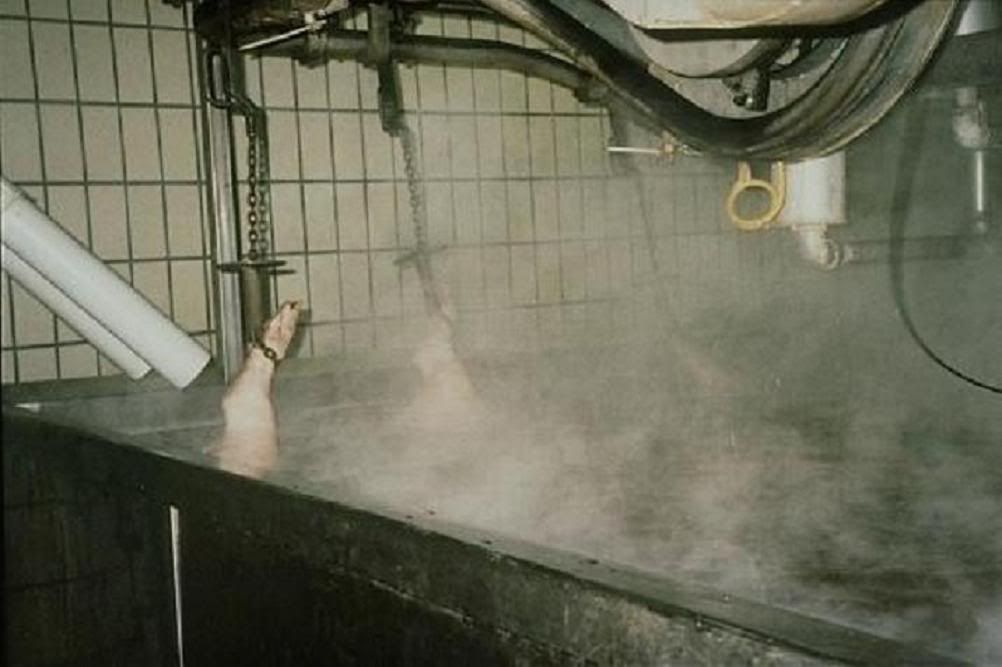
I think they die slowly from drowning."
"When a conscious cow arrives at the first hind-legger, usually the
legger tries to make a cut to start skinning out the leg.
Unfortunately, it is very difficult and dangerous to do that when an
animal is kicking violently. So the legger will cut off the bottom part
of the animal's leg he's working on with a pair of clippers.
"
Her book does a remarkable job of exposing the cruelty applied to 8
billion farm animals each year. Each one dies a painful death.
Killers become so used to the act of killing that these animals are treated with great disdain.
Sometimes they are brutally tortured before and during
death.
Robert Cohen
Executive Director
Dairy Education Board
NotMilk.com<>
Slaughterhouse:.. The Shocking Story of Greed, Neglect, and Inhumane Treatment Inside the U.S. Meat Industry
"When we tell ourselves we're eating meat from "humanely raised animals," we're leaving out a huge part of the equation. The slaughtering of an animal is a bloody and violent act, and death does not come easy for those who want to live."
" Colleen Patrick-..Goudreau
Friday, September 11, 2009
Animal Visuals :: Visual Resources for Animal Advocates
Fact Sheet: Battery Cages
Updated February 12, 2009
Click a fact to show references. Show all. Hide all.
- In the United States, an estimated 95% of egg-laying hens are intensively confined in battery cages.
United Egg Producers. (2008 Edition, published 2003). United Egg Producers Animal Husbandry Guidelines For U.S. Egg Laying Flocks. Retrieved November 15, 2008. page 1, paragraph 6.
- As of December 2008, about 300 million birds are confined in battery cages, almost one for every U.S. citizen.
USDA National Agriculture Statistics Service. (2008). Chickens and Eggs. Retrieved December 16, 2008. page 1.
- Each cage confines 5 or 6 birds on average, but sometimes up to 10 birds.
USDA/Animal and Plant Health Inspection Service, Veterinary Services. National Animal Health Monitoring System. (2000). Layers '99. Part II: Reference of 1999 Table Egg Layer Management in the U.S. Retrieved December 16, 2008. page 22: The average number of chickens per cage is about 5.6.
Shields, Sara, and Ian J.H. Duncan. (2006). An HSUS Report: A Comparison of the Welfare of Hens in Battery Cages and Alternative Systems. Retrieved December 18, 2008. Under "Cages and Alternative Systems," it states that the most commonly used cages hold 5-10 birds per cage.
Compassion Over Killing. (2005). New COK Investigation Leads to Criminal Charges of Animal Cruelty: Excerpts from the Investigator's Log Notes. Retrieved December 18, 2008. Notes from Wednesday, November 30, 2005 at Ebenshade Farms in Pennsylvania, investigator noted that most of the birds were overcrowded in cages, with as many as 10 birds per cage.- Voluntary industry guidelines specify a minimum of 67 square inches per hen. This is an area smaller than a standard sheet of paper.
United Egg Producers. (2008 Edition, published 2003). United Egg Producers Animal Husbandry Guidelines For U.S. Egg Laying Flocks. Retrieved November 15, 2008. page 11, paragraph 1.
- Like any animal, chickens are highly motivated to perform natural behaviors. These behaviors include nesting, perching, scratching, foraging, dust-bathing, exploring, and stretching. Caged chickens are denied all of these natural behaviors, causing them severe frustration.
Shields, Sara, and Ian J.H. Duncan. (2006). An HSUS Report: A Comparison of the Welfare of Hens in Battery Cages and Alternative Systems. Retrieved December 18, 2008. This document provides a summary of natural chicken behavior and how it is frustrated by battery cage confinement.
- Battery hens suffer from serious health problems, such as respiratory disease from constant exposure to ammonia fumes and fecal dust; osteoporosis, bone fractures, and prolapsed uteruses from being bred to lay eggs at an unnaturally high rate; and foot disorders, sores, and injuries from contact with the cage wire in outdated cage systems.
Shields, Sara, and Ian J.H. Duncan. (2006). An HSUS Report: A Comparison of the Welfare of Hens in Battery Cages and Alternative Systems. Retrieved December 18, 2008. This document provides a summary of diseases and health problems battery chickens suffer.
The Humane Society of the United States. (2008). An HSUS Report: Welfare Issues with Selective Breeding of Egg-Laying Hens for Productivity. Retrieved December 19, 2008. More detail on osteoporosis and cloacal prolapse resulting from selective breeding.- As a response to the lack of foraging opportunities in the barren cage environment, chickens sometimes engage in feather-pecking of their cagemates. So, before they are 10 days old, the ends of their beaks are seared off with hot blades.
United Egg Producers. (2008 Edition, published 2003). United Egg Producers Animal Husbandry Guidelines For U.S. Egg Laying Flocks. Retrieved November 15, 2008. page 4: Guidelines for beak trimming.
- Beak mutilation causes acute and sometimes chronic pain.
Shields, Sara, and Ian J.H. Duncan. (2006). An HSUS Report: A Comparison of the Welfare of Hens in Battery Cages and Alternative Systems. Retrieved December 18, 2008. page 5: "Abnormal Behavior: Cannibalism and Feather-Pecking."
- For every egg you buy, a hen will be forced to endure these conditions for over 32 hours.
USDA National Agriculture Statistics Service. (2008). Chickens and Eggs. Retrieved December 16, 2008. page 1: Egg production for October 2008 was 2,276 eggs per 100 layers. This is 22.76 eggs per month per bird, which translates to 32.68 hours per egg, given that October has 31 days.
- Chickens are confined for about a year and a half before their ability to lay eggs declines, then they are killed.
USDA/Animal and Plant Health Inspection Service, Veterinary Services. National Animal Health Monitoring System. (2000). Layers '99. Part II: Reference of 1999 Table Egg Layer Management in the U.S. Retrieved December 16, 2008. page 23: The average age of laying hens entering battery cages is 17.5 weeks. Page 29: The average age of laying hens at slaughter is 101.5 weeks. 101.5-17.5 = 84 weeks, or about 19 months.
- Eggs are not a necessary part of a nutritious diet, and there are many healthy, affordable alternatives that make it easy to leave eggs off of your shopping list for good. Some good egg alternatives include applesauce, bananas, commercial egg replacer powder (such as Ener-G Egg Replacer or Bob's Red Mill All Natural Egg Replacer) ground flaxseed, tofu, or vinegar and baking soda.
For more information about how easy it is to replace eggs, see the following links:
- The egg industry cannot be trusted to make responsible decisions regarding the welfare of chickens, because it has a profit motive to sacrifice their interests. There are currently no U.S. federal laws that protect the interests of chickens used for food.
USDA/Animal and Plant Health Inspection Service. (2007). Animal Welfare Act Retrieved January 29, 2009. Section 2132, Definitions, part g. In the Animal Welfare Act, the word "animal" excludes poultry.

Animal Visuals :: Visual Resources for Animal Advocates
ORDER YOUR FREE VEGETARIAN STARTER KIT HERE!
Tuesday, August 25, 2009
Transportation of Farm Animals Investigation
Originally Posted by:
Lizzie Wylder Apr 22
This is a video of a 2005 investigation of a US farm animal transportation done by Compassion Over Killing. Unfortunately, this is not an isolated case. Animals being transported to slaughterhouses are crammed tightly into trucks, and travel for more than 28 hours without food, water or rest. They are exposed to harsh weather, and die from heat exhaustion or freeze to death -- often being frozen to the side of the truck -- before even making it to the slaughterhouse. These animals are treated as nothing more than money gaining products from the time they are born, during transport, and when they are slaughtered. They have done harm to no one, and yet are given no mercy. Go to tryveg.com and cok.net to learn more about animals who are raised for food and the best way you can help them.
http://www.youtube.com/watch?v=HeUWDdngafQ&feature=player_embedded